
Table of Contents
- Tools and Supplies for Cleaning Fine Jewelry
- How to Clean Diamond Rings at Home
- Safe Jewelry Cleaning Solutions for Gold
- Cleaning Silver Jewelry: Removing Tarnish vs. Dirt
- How Often to Clean Fine Jewelry
- What to Avoid When Cleaning Fine Jewelry
- When to See a Professional Jeweler
- Conclusion
- Frequently Asked Questions
Last Updated: September 22, 2026
Tools and Supplies for Cleaning Fine Jewelry
The best ways to clean fine jewelry start with the right tools, not the harshest ones. Most pieces need only a mild dish detergent, lukewarm water, a soft-bristled toothbrush, and a microfiber cloth. At LushJewels_byMide, we handle 18Kt gold and natural diamonds daily, and the same gentle supplies work on nearly everything.
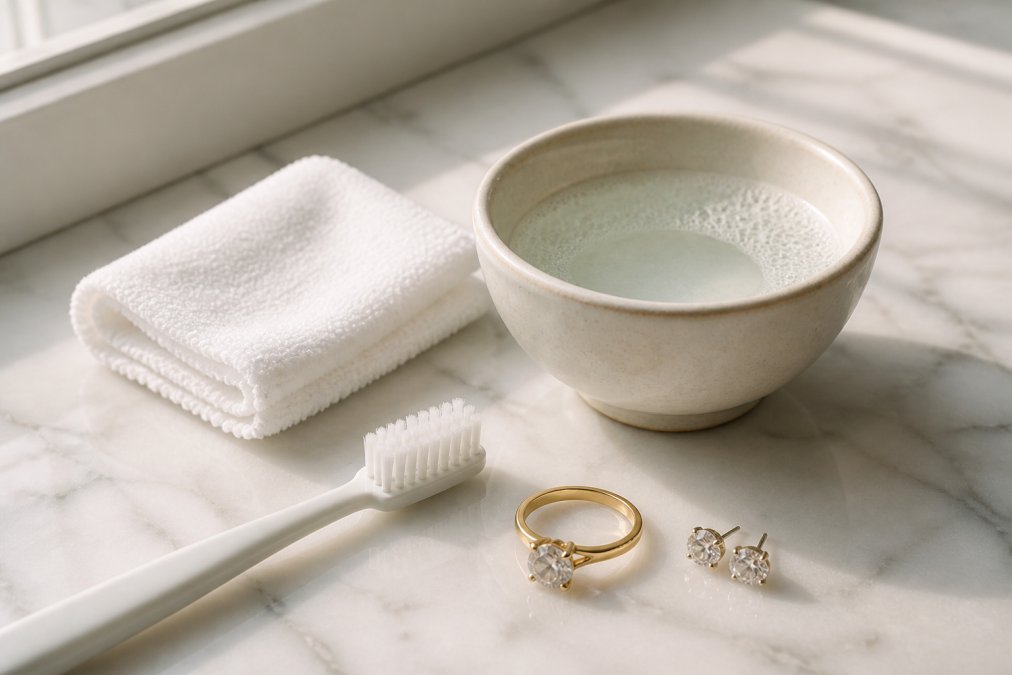
Here is what belongs in a basic cleaning kit:
- Mild dish detergent, ammonia-free and non-abrasive
- Lukewarm water in a small bowl
- Soft-bristled toothbrush for crevices and settings
- Microfiber cloth for drying and polishing
- A fine-mesh strainer to catch loose stones over the drain
How to Clean Diamond Rings at Home
Learning how to clean diamond rings at home takes about ten minutes and no special skill. Diamonds are hard, but they hold grease and lotion that dull their sparkle. A mild soak lifts that film without touching the stone.
Follow these steps:
- Fill a bowl with lukewarm water and a few drops of mild dish detergent.
- Let the ring soak for 15 to 20 minutes.
- Brush gently around the prongs and under the setting with a soft-bristled toothbrush.
- Rinse under lukewarm water, catching the ring in a strainer.
- Pat dry with a microfiber cloth.
Safe Jewelry Cleaning Solutions for Gold
Safe jewelry cleaning solutions for gold come down to one rule: match the solution to the metal. Solid 18Kt gold tolerates mild soap and water well. Gold plating and vermeil do not, because soaking and brushing wear away the thin layer of gold.
| Metal Type | Safe Method | Avoid |
|---|---|---|
| Solid 18Kt gold | Mild soap, lukewarm water, soft brush | Chlorine, abrasives |
| Gold plating / vermeil | Damp cloth wipe, pat dry | Soaking, brushing, polish |
| Sterling silver | Mild soap or silver polishing cloth | Harsh dips on gemstones |
| Diamond settings | Soak, soft brush, rinse | Steam, ultrasonic if loose |
Cleaning Silver Jewelry: Removing Tarnish vs. Dirt
Cleaning silver jewelry means knowing which problem you have. Dirt is surface grime that washes off with mild soap and water. Tarnish is oxidation, a chemical darkening of the metal itself, and it needs a different approach.
- Dirt: mild dish detergent, lukewarm water, soft brush
- Light tarnish: silver polishing cloth, buff gently
- Heavy tarnish on plain silver: brief silver dip, rinse well
- Silver with stones: soap and water only, pat dry
How Often to Clean Fine Jewelry
How often to clean fine jewelry depends on how often you wear it and what it is made of. There is no universal schedule, and treating one like a rule is how people either over-polish soft metals or let diamonds sit dull for months.
A workable baseline:
- Worn daily (rings, studs, wedding bands): quick soap-and-water wash every two to four weeks. These pieces collect lotion, sunscreen, hair product, and skin oils fast, and that film is what kills sparkle.
- Worn a few times a month: clean before each wear, or at minimum once a month.
- Worn a few times a year: clean before each wear and again before storing.
- Sterling silver, worn or not: check monthly. Silver tarnishes on its own in open air, so a piece sitting in a drawer can darken without ever being touched.
- Deep clean (full soak-and-brush): every one to three months for most pieces. More often than that wears down plated finishes and over-polishes silver.
Post-cleaning inspection: the step almost everyone skips
The best moment to inspect a piece is right after you clean it, while it is dry and you are already looking closely. Cleaning removes the grime that hides problems, so a loose prong that was invisible before suddenly shows up.
Run through this after every wash:
- Prong check. Look at each prong under bright light. They should sit snug against the stone with no gap. A prong that has pulled back or looks bent is a repair, not a cleaning issue.
- Stone check. Press gently on the stone with a fingernail or a soft cloth. If it shifts, rattles, or clicks, stop wearing the piece until a jeweler tightens the setting.
- Setting check. On channel, bezel, and pave settings, look for missing melee stones. Tiny stones fall out quietly and are far cheaper to replace before the surrounding stones loosen.
- Clasp and hinge check. On bracelets and necklaces, open and close the clasp a few times. A clasp that feels loose or does not click is the most common cause of lost jewelry.
- Surface check. Look for new scratches, dents, or a thinning band. A ring shank worn thin at the bottom is a sign it needs re-shanking before it cracks.
Storage that actually protects the schedule
How you store a piece determines how often it needs cleaning in the first place.
- Store each piece separately in a soft pouch or a lined compartment. Diamonds are hard enough to scratch gold, platinum, and softer stones, so loose diamonds in a shared box cause damage on their own.
- Keep sterling silver in a tarnish-resistant pouch or a zip bag with the air pressed out. Open air is what drives tarnish.
- Keep pearls away from other jewelry and away from direct heat. Pearls are soft and scratch easily, and their nacre dries out in low humidity.
- Store pieces dry. Putting a damp ring back in a box traps moisture against the metal and speeds tarnish and, on some alloys, corrosion.
The annual professional inspection
Once a year, take any piece you wear daily to a jeweler for an inspection under magnification. They will check prongs, settings, clasps, and the shank, tighten what has loosened, and catch wear before a stone falls out. Pair that annual visit with your own post-cleaning checks and most structural failures get caught months before they become losses.
What to Avoid When Cleaning Fine Jewelry
The fastest way to damage a piece is to clean it with the wrong product. Abrasive cleaners, harsh chemicals, and some household standbys cause permanent harm that no jeweler can reverse. The trick is knowing which rule applies to which stone, because a method that rescues a diamond can ruin an opal in a single soak.
Avoid these across the board:
- Abrasive cleaners and scouring pads, which scratch metal and settings
- Chlorine and bleach, which pit gold alloys and weaken prong solder over repeated exposure
- Ammonia-based window and glass cleaners, which strip the oils that hold pearls and dull porous stones
- Toothpaste, which is abrasive despite the persistent home-remedy advice
- Baking soda and salt pastes, which micro-scratch polished metal and get trapped under settings
Gemstone safety: what can and cannot take a soak
Most guides lump every gem into one bucket. That is the single most common cause of DIY damage. Porous and organic stones absorb liquid, and once a colored solution or detergent seeps in, the cloudiness or color shift is permanent.
| Stone | Soak in mild soap + water? | Soft brush? | Ultrasonic? |
|---|---|---|---|
| Diamond | Yes | Yes | Only if setting is tight and stone is untreated |
| Ruby, sapphire | Yes | Yes | Generally yes, untreated stones only |
| Emerald | Brief only | Yes, very gently | No, typically oil- or resin-treated |
| Opal | No | Damp cloth only | No |
| Pearl | No | Damp cloth only | No |
| Turquoise | No | Damp cloth only | No |
| Amethyst, citrine | Brief only | Yes | No, heat and vibration can fade color |
| Tanzanite | No | Damp cloth only | No |
Ultrasonic cleaner risks
Home ultrasonic cleaners are widely sold and widely misused. They work by pushing high-frequency vibration through a liquid bath, which shakes grime loose from crevices a brush cannot reach. That same vibration does three dangerous things:
- It can shake a stone free from a prong that was already slightly loose, a problem you would not have noticed until the stone was gone.
- It can widen hairline fractures in fracture-filled diamonds, and the filler itself can be vibrated out.
- It can chip or craze softer stones and any stone with an existing internal fracture.
Tarnish is not dirt
A separate mistake is treating oxidation like grime. Dirt sits on the surface and washes off with mild soap and water. Tarnish is a chemical change in the metal itself, usually silver sulfide, and soap will not touch it. Using an abrasive to scrub tarnish off silver removes metal along with the discoloration, thinning the piece a little every time.
When to See a Professional Jeweler
Some problems are not DIY. See a professional jeweler when a stone feels loose, a prong looks bent, or a clasp stops holding. These are structural issues, not cleaning issues, and cleaning will not fix them.
At LushJewels_byMide, we see the difference routine care makes.
Conclusion
Fine jewelry rewards gentle, consistent care, and the wrong shortcut can undo years of craftsmanship. If you would rather trust your pieces to expert hands, LushJewels_byMide is here. Our collection features 18Kt gold and natural diamonds, crafted with the same care we recommend for cleaning them. Continue shopping with LushJewels_byMide and keep your collection brilliant for decades.
Frequently Asked Questions
Is it better to clean jewelry with alcohol or peroxide?
Neither is recommended for fine jewelry. Alcohol can dry out or damage certain gemstones and may strip finishes, while peroxide is a mild bleach that can harm porous stones and some metals. For safe cleaning, use mild dish detergent and lukewarm water. For diamond rings, a soft-bristled toothbrush helps remove buildup. If you need to disinfect, consult a professional jeweler for advice specific to your piece.
What should you not clean jewelry with?
Avoid abrasive cleaners, harsh chemicals like ammonia or chlorine, and acidic substances such as vinegar or lemon juice on delicate gemstones. Ultrasonic cleaners can damage porous stones or loosen settings, so use them only if a jeweler confirms it's safe. Never use toothpaste, baking soda, or bleach. These can scratch metal, erode plating, or harm gemstone integrity. Always check with a professional before trying any new method.
How often should you have fine jewelry professionally cleaned?
A professional cleaning and inspection once or twice a year is ideal for most fine jewelry. If you wear a piece daily, such as a diamond ring, consider a check every six months to catch loose prongs or worn settings. Between visits, clean at home every few weeks using mild dish detergent and lukewarm water. Regular maintenance helps preserve brilliance and prevents damage, especially for pieces with porous gemstones or intricate designs.
Does Dawn soap clean jewelry?
Dawn is a mild dish detergent that can be used to clean many types of fine jewelry, including gold and diamond pieces. It effectively removes oils and buildup when mixed with lukewarm water. However, it's not suitable for porous gemstones like opals, pearls, or emeralds. Always use a soft-bristled toothbrush and rinse thoroughly. For best results, dry with a microfiber cloth. When in doubt, ask a jeweler if Dawn is safe for your specific piece.